How caregivers can keep dignity intact when conversations get tense
Aging Untold experts share ways to build cooperation and reset when stress turns into sharp words
(Aging Untold) — Stress can turn into sharp words when you are a caregiver for someone you love.
The Aging Untold experts are sharing advice on how to communicate in a way that keeps dignity intact, builds cooperation and helps caregivers reset when a conversation escalates.
Step away before things escalate
“Sam” Cradduck, a gerontologist, said the first move to make when it feels like a conversation is about to escalate is to leave the room.
“You have to step away. You really do,” Cradduck said. “You’ve got to let yourself calm down.”
Aging well coach Katherine Ambrose said caregivers can take that step by removing themselves or getting help.
“If you’re fantasizing about escaping, or noticing the yellow flags like you’re starting to get hot, shaky, your jaw’s tense, that’s a good time to go, ‘OK, my nervous system is at its limit,’” Ambrose said.
Treat communication as behavior
Caregivers should consider what the person they care for is going through, Cradduck said.
“Their communication is really behavior,” Cradduck said. “You’ve got to figure out what’s going on that’s causing the frustration.”
She said unspoken expectations can also cause conflict.
“You expecting something from somebody oftentimes turns into spoken resentment,” Cradduck said. “So then, you’re frustrated and you’re yelling and they have no idea.”
A person may be cognitively whole and still not know what a caregiver wants if the caregiver has not said it, she said.
Choose words and tone with care
Aging expert Amy O’Rourke listed words that can escalate a conversation:
- No
- You
- Always
- Never
- Don’t
- You can’t
In addition to the words, tone affects how a caregiver is perceived, Cradduck added.
“It’s not just what you say, it’s how you say it,” Cradduck said.
“If you want to have a better day, have a better tone,” Ambrose said.
She said miscommunication is often the source of conflict.
“All drama and conflict comes from one thing, and that’s miscommunication,” Ambrose said.
She said the way a person communicates is a cue to how that person is feeling, and caregivers should have the emotional maturity to manage themselves.
Meet people where they are
O’Rourke described a visit to her father in a nursing home. He was upset about a missing key for his wheelchair, and staff members were upset with him for being upset. She said she took out a key, turned it on the arm of the chair and got it to work.
Her heart rate went up in that moment, despite her training.
“But then I realized, I don’t have to be right,” O’Rourke said. “I can let go and be with him where he is.”
Dr. Rhea Rogers, a board-certified physician, said that when communication is off and there’s a misunderstanding, people begin to second-guess themselves and things can spiral toward anger.
A caregiver can be as distraught as the person receiving care, she said.
Check negative self-talk and name the fear
The Aging Untold experts also addressed negative thoughts and venting to others.
Ambrose said she sees “low-level energy” in Facebook groups where people complain about the person they care for or about others involved — and that kind of drama will make the caregiver more miserable.
But Cradduck said she likes that such groups exist because caregivers can vent in a safe place before they walk into the room.
Negative thoughts, such as “she just never listens to me,” lead to negative and hurtful words, she said.
O’Rourke said venting about fears, frustrations and stress to someone else helps a caregiver feel more balanced going into another conversation.
Rogers addressed underlying fear and said it is something caregivers do not talk about enough.
Go in without a set outcome, and treat adults as adults
How a caregiver goes into the conversation matters too.
O’Rourke said that a caregiver who goes into one with a specific outcome in mind “will lose.” BUt a caregiver who goes in with no outcome, aiming for a successful connection, can build on that.
Cradduck cautioned that caregivers should not treat an adult like a child.
“When you’re trying to parent or you’re trying to correct them like you would a child, then you’re creating a conflict because they’re not going to be happy,” Cradduck said.
The caregiver has to be “the peaceful adult” and keep the calm, but that it is not always easy, she said.
Key takeaways
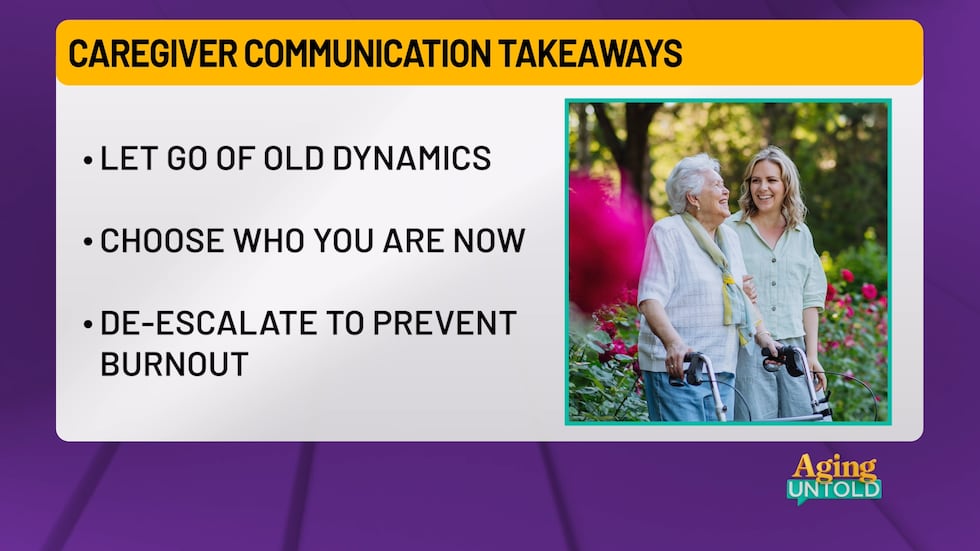
- Step away to calm down. Remove yourself or get help when you notice signs such as feeling hot, shaky or tense in the jaw.
- See communication as behavior. Consider what the person you care for is going through and what is causing the frustration.
- Say what you expect. Unspoken expectations can turn into spoken resentment.
- Watch your tone and your self-talk. Tone affects how you are perceived, and negative thoughts can lead to hurtful words.
- Ditch the “dance of normalcy” and reclaim your agency. Let go of old relationship dynamics and choose who you want to be now, even when the past is complicated.
- De-escalate to prevent burnout.
This program is provided for educational and informational purposes only and does not constitute providing medical advice or professional services. The information provided should not be used for diagnosing or treating a health problem or disease, and those seeking personal medical advice should consult with a licensed physician. Always seek the advice of your doctor or other qualified health provider regarding a medical condition. Never disregard professional medical advice or delay in seeking it because of something you have seen on this program. If you think you may have a medical emergency, call 911 or go to the nearest emergency room immediately. No physician-patient relationship is created by this program or its use. Aging Untold/Gray Media, nor its employees, contractors or agents, nor any contributor to this program, makes any representations, express or implied, with respect to the information provided herein or to its use.
Copyright 2026 Gray Media Group, Inc. All Rights Reserved.