WWI Memorial holds hidden history more than 100 years later
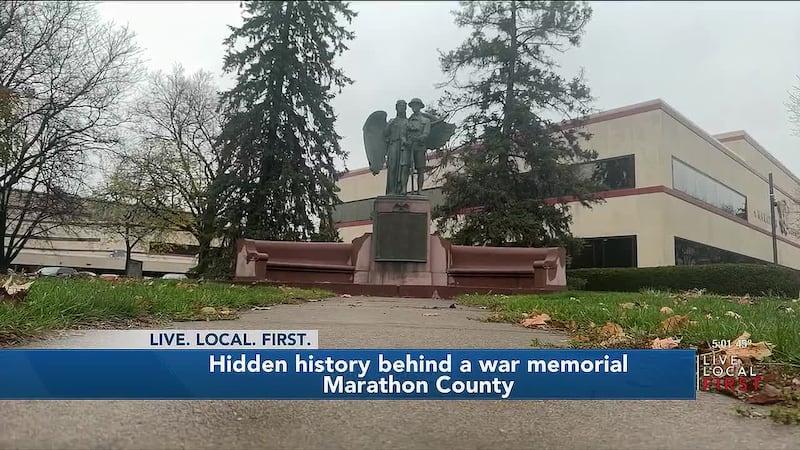
WAUSAU, Wis. (WSAW) - On the busy corner of 5th Street and Forest near downtown Wausau, it’s easy to miss a memorial to the Marathon County residents who died in WWI.
But besides marking a moment in time, the monument to those killed between 1917 and 1918 holds a history of its own.
In fact, it would take many months, multiple twists, and multiple moments of sacrifice before the statue became a reality.
Community fundraising
The story starts in 1922, just a few years after the end of “The Great War”.
Ben Clark, the historian for the Marathon County Historical Society, said the idea for the monument came from the VFW, which back then was a newer organization.
“They put out a call for the public, and they ended up very quickly raising about $20,000, which is, adjusted for inflation, about $400,000 today,” Clark said.
According to Clark, the “Roaring 20’s” were not yet roaring in Marathon County. In 1922, residents were actually experiencing an economic downturn.
“That money that they raised, that didn’t come from people that had a lot to throw at, you know, extravagance,” said Clark. “It was people that were really, you know, struggling.”
Renowned artist steps in
Once the money was raised, the project went full steam ahead.
The designer, Carl Haber, was one of the most renowned public monument artists in the United States at the time.
“Apparently somebody local knew him personally,” said Clark. “[Haber] kind of spent a little time here and then kind of came up with a design that he pitched to the committee.”
The final design features a soldier in the uniform of the time, complete with a shrapnel helmet and gas mask. His hands rest on his rifle. An angel stands at his side, its arms and wings wrapped around him in protection.
The plaque below is inscribed with the names of 132 Marathon County residents who died during the Great War.
“I think the phrase that they were trying to emulate was valor, patriotism, faith, and hope. And so ultimately [Haber] kind of picked the representation of a sort of generic person,” said Clark.
Clark said the design is intentional.
“[The statue] doesn’t represent any of the 132 people listed on the plaque, but also represents all of them in that same way.”
“A few weeks of anxiety”
Initially, the memorial was wanted for Veterans Day in 1922, but logistics pushed the date back to Memorial Day of 1923.
But just a few weeks before the deadline, there was a snag in the plans, causing “a few weeks of anxiety”, according to Clark.
The Philadelphia foundry where the bronze statue was being cast had been hit by a flu outbreak, and the project looked to be in peril.
“One of the members from the committee went out to Philadelphia and... was able to pitch directly to the workers who were overworked,” said Clark.
The workers agreed to work overtime, pulling 12-hour days to complete the monument on time, even bringing in extra help. “We actually got the Navy to release somebody in order to work, specialty, to make this happen in time to get it done,” Clark said.
But that wasn’t the end of the problems.
“[The statue] gets to Chicago, where the train goes, ‘yeah, no, we’re not shipping that to Wisconsin. It’s too heavy,” Clark recounted.
Marathon County locals just happened to be in Chicago at the time, and called up a Wausau leader to intervene: none other than Wausau business leader Cyrus Yawkey.
“He had connections. And lo and behold, it got on the train and got here all in time,” said Clark.
The monument, draped in an American flag, was unveiled on Memorial Day of 1923, to a crowd of thousands.
A new home
The monument didn’t always sit in the shadow of the current Marathon County courthouse.
“Originally, when this was put in, this would have been on the northwest corner of what is today the 400 Block, on Scott and 3rd Street,” said Clark, which is a very busy intersection, even back then."
The statue and its benches were moved in the 1950’s when the current courthouse was built.
Statue still relevant
When the memorial was new, the names on the plaque held an immediate significance.
“I think no matter where you came from in Marathon County, you probably knew one of these people,” said Clark. “In 1923 when they unveil it, it’s an act of the community coming together to say, this is important to us.”
But while the memory of those who died, and those who built the monument are long gone, Clark thinks there’s still a broad appreciation for the sacrifice those involved ultimately made.
“You know, you don’t have to know very much about World War I or World War II or any of the other sort of conflicts that are represented here on the courthouse grounds to recognize that there’s still, you know, something valuable. And that’s why we continue to maintain and remember.”
Click here to download the WSAW news app or WSAW First Alert weather app.
Click here to submit a news tip or story idea.
Copyright 2026 WSAW. All rights reserved.