‘I started crying’: Woman with Down syndrome denied boarding pass for flight. Here’s why
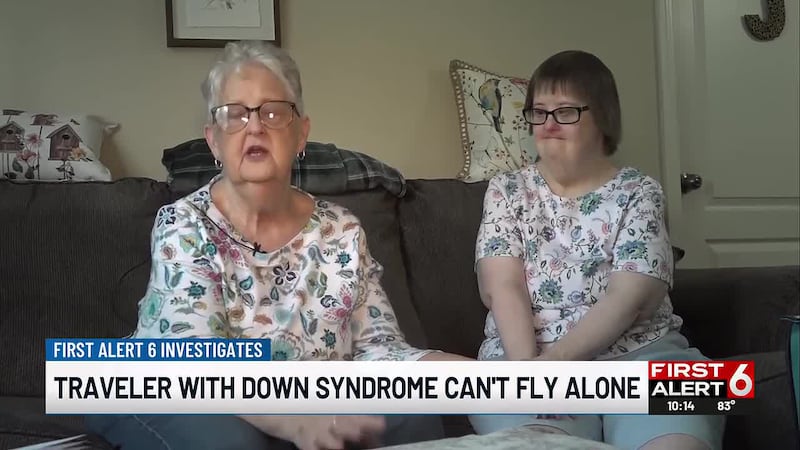
OMAHA, Neb. (WOWT/Gray News) - An Omaha woman with Down syndrome was denied a boarding pass at the airport last month after airline staff determined she required a safety assistant to fly.
Jennifer Jaspers, 52, had planned a solo birthday trip to North Carolina to visit her father and cousins.
“So I can meet my new cousin,” Jaspers said.
On July 23, her mother, Cindy Garrett, brought her to the American Airlines counter to check in for an early morning flight at Eppley Airfield.
Garrett said her daughter has flown alone dozens of times.
“I can fly by myself,” Jaspers said.
During the check-in process, Jaspers was asked whether she could exit a building on her own.
“Whether she could get herself out of a building by herself — and she said I don’t know, because it threw her; she didn’t know how to answer that,” Garrett said.
Garrett also said accommodations had previously been put in place for her daughter during flights. She said they had set it up so an employee would walk with Jaspers to her next gate.
“I said there’s never been a problem. She has a phone in her purse all the time and she knows how to use it,” Garrett said.
A supervisor became involved in the assessment, and Jaspers was denied a boarding pass.
“I started crying at the airport,” Jaspers said.
A spokesperson for American Airlines said it is the airline’s policy that customers who are unable to follow safety instructions during their flight are required to have a safety assistant.
The spokesperson said airport staff had followed its procedures in determining if Jaspers needed a safety assistant. The staff concluded that she did need one and the option was offered at no cost, according to American Airlines.
Garrett said Jaspers had a first-class ticket, but wouldn’t be able to fly first class with a safety assistant.
According to the American Airlines spokesperson, her ticket was refunded.
American Airlines said this is not a new policy and can be found on the airline’s website under the special assistance page.
Elizabeth Draney, director of the Down Syndrome Alliance, said many people with Down syndrome fly alone and that the denial raises questions about how the airline applies its screening criteria.
“If they have these questions they ask to determine if someone can fly, who are they deciding who to ask those questions to — that would be something I wonder about,” Draney said.
As for Jaspers, she never unpacked after the ordeal and still wants to travel to North Carolina.
Garrett said Jaspers’s father spent two weeks and $1,800 arranging a round-trip flight from North Carolina to Omaha to serve as her travel assistant.
The family plans to ask American Airlines whether the no-cost safety assistant offer still applies.
“If they’re the ones that say she needs a second person, then at least half of it they should pay,” Garrett said.
The U.S. Department of Transportation said an airline may only require a passenger to travel with a safety assistant under limited circumstances, such as the inability to comprehend safety instructions.
If a passenger disagrees with the airline’s self-assessment, the airline cannot charge the travel assistant for a ticket.
“The Department takes allegations of disability-related discrimination seriously. Any consumer who believes an airline has violated their rights can file a complaint directly with the airline and USDOT,” the department said in a statement.
Copyright 2026 WOWT via Gray Local Media, Inc. All rights reserved.